

Hey there! As a supplier of non - standard sprockets, I get asked a lot of interesting questions. One that recently popped up a bunch is: "What is the Poisson's ratio of a non - standard sprocket?" Let's dig into this topic and see what we can find out.
First off, for those who aren't familiar, Poisson's ratio is a pretty cool concept in mechanics. When you stretch or compress a material in one direction, it usually changes shape in the other directions too. Poisson's ratio is the negative ratio of the transverse strain (the change in width or thickness) to the axial strain (the change in length). It's a number that helps us understand how a material behaves under stress.
Now, non - standard sprockets are different from the regular ones you might find on the shelf. They're custom - made to fit specific applications, and they can be made from a wide range of materials. Each material has its own Poisson's ratio, and that can have a big impact on how the sprocket performs.
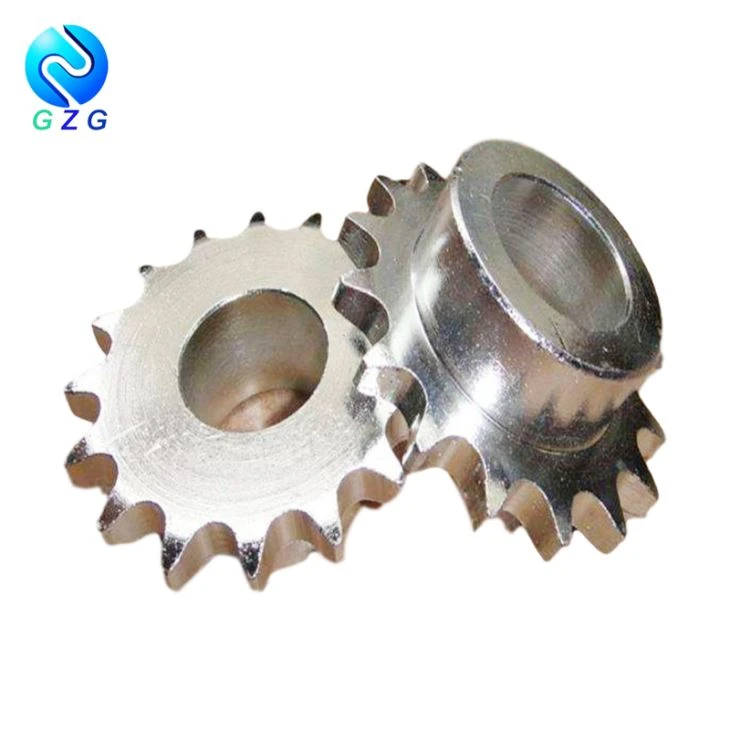

Let's talk about some of the materials we use to make our non - standard sprockets. We've got options like metals, plastics, and more. Metals are super common because they're strong and durable. For example, steel sprockets are a popular choice. Steel typically has a Poisson's ratio between 0.27 and 0.30. This means that when you pull on a steel sprocket in one direction, it'll contract in the perpendicular directions by an amount related to this ratio.
If you're interested in Non-standard sprocket manufacturing, we can handle the custom work based on different materials, each with its own Poisson's characteristics.
Plastics are another material we use for non - standard sprockets. They're lightweight, corrosion - resistant, and can be a great option for certain applications. Plastic sprocket materials can have a much wider range of Poisson's ratios. For instance, some plastics might have a Poisson's ratio closer to 0.4. This higher ratio means that they'll deform more in the transverse direction when under axial stress compared to steel.
The surface treatment of a non - standard sprocket can also play a role, even though it doesn't directly affect the Poisson's ratio of the base material. We offer different surface treatments like a Black Sprocket On Surface or a Galvanized Sprocket On Surface. These treatments are mainly for protection and appearance, but they can influence how the sprocket behaves under load in combination with the base material's properties.
One of our unique products is the HUB Chain Sprocket C Type. The Poisson's ratio of the material used in this sprocket is crucial for its performance. If the ratio is off, it could lead to issues like excessive wear, misalignment, or even failure under high loads.
Why does the Poisson's ratio matter so much for non - standard sprockets? Well, in a real - world application, the sprocket needs to transfer power efficiently. If the material deforms too much in the wrong way due to its Poisson's ratio, it can cause the chain to slip, or it might not mesh properly with other components. This can lead to a decrease in performance and potentially costly repairs.
For example, in a high - speed conveyor system, a non - standard sprocket with an inappropriate Poisson's ratio might cause vibrations. These vibrations can wear out the chain and other parts faster, reducing the overall lifespan of the system. On the other hand, a well - chosen sprocket with the right material and Poisson's ratio can keep the system running smoothly for a long time.
When we're designing a non - standard sprocket for a customer, we take the Poisson's ratio into careful consideration. We need to know the application, the loads it'll be under, and the environment it'll operate in. Based on that, we pick the best material with the most suitable Poisson's ratio.
Let's say you're working on a project that requires a sprocket to handle high torque. We'd likely choose a material with a lower Poisson's ratio, like steel. This is because a lower ratio means less transverse deformation, which is important when you're dealing with high - stress situations. The sprocket will be able to maintain its shape better, and the chain will stay in place more effectively.
On the other hand, if weight is a major concern, like in a lightweight robotic system, we might opt for a plastic sprocket. A plastic with a higher Poisson's ratio can still work well as long as the design takes into account the additional transverse deformation.
Another factor to consider is the manufacturing process. When we make a non - standard sprocket, factors like machining operations, heat treatment, and welding can affect the material properties to some extent. These processes can sometimes change the internal structure of the material, which might have a minor impact on the Poisson's ratio. But don't worry, we're experts at keeping these changes in check. We carefully monitor and control the manufacturing process to ensure that the final sprocket has the properties we expect, including the right Poisson's ratio within the acceptable range.
In conclusion, understanding the Poisson's ratio of a non - standard sprocket is super important. It affects how the sprocket performs in different applications, and it's one of the key factors we consider when designing and manufacturing these custom parts.
If you're in the market for non - standard sprockets for your project, we're here to help. We've got the expertise to choose the right material and make sure the Poisson's ratio is perfect for your needs. Reach out to us for a quote or to discuss your specific requirements. Let's work together to get you the best non - standard sprockets for your application.
References
- Mechanics of Materials textbooks (various editions for general knowledge on Poisson's ratio)
- Industry - specific handbooks on sprocket design and manufacturing