

When it comes to the world of power transmission, HUB sprockets play a crucial role. As a leading HUB sprocket supplier, I understand the importance of accurately calculating the number of teeth for a HUB sprocket. This calculation is not just a matter of numbers; it directly impacts the performance, efficiency, and longevity of the entire power - transmission system. In this blog, I will guide you through the process of calculating the number of teeth for a HUB sprocket.
Understanding the Basics of HUB Sprockets
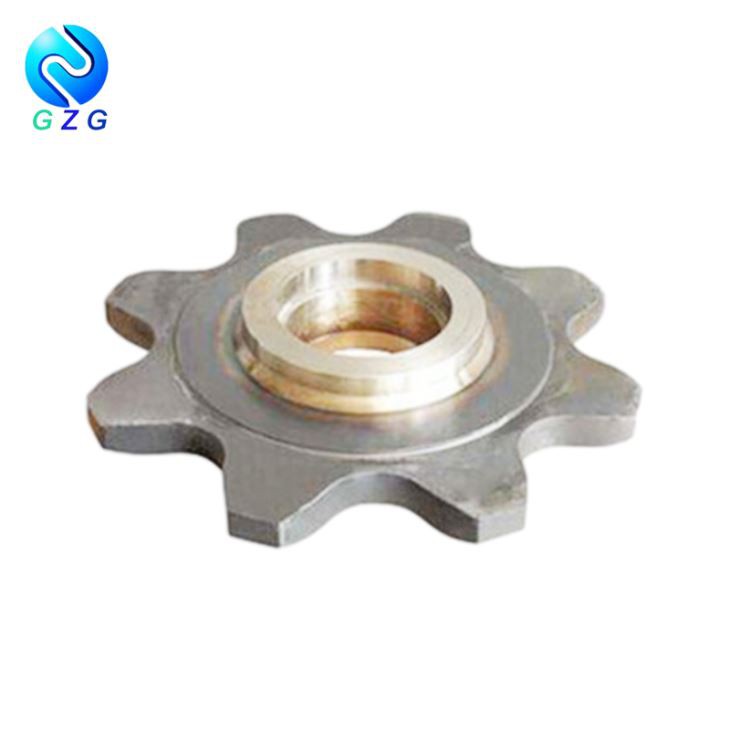
Before delving into the calculation, it's essential to understand what HUB sprockets are. HUB sprockets are mechanical components with teeth that mesh with a chain, belt, or other flexible transmission elements. They are commonly used in various industries, such as manufacturing, automotive, and agriculture, to transfer rotational motion and power from one shaft to another.
The design of a HUB sprocket is characterized by its hub, which provides a secure connection to the shaft. The teeth on the sprocket are precisely shaped to engage with the corresponding links of the chain or belt, ensuring smooth and efficient power transfer.
Factors Affecting the Number of Teeth
Several factors influence the number of teeth a HUB sprocket should have. These factors need to be carefully considered to ensure optimal performance of the power - transmission system.
1. Speed Ratio
The speed ratio is one of the most critical factors. It is defined as the ratio of the rotational speed of the driving sprocket to the rotational speed of the driven sprocket. If you need to increase the speed of the driven shaft, you will typically use a driving sprocket with more teeth than the driven sprocket. Conversely, if you want to decrease the speed, the driving sprocket should have fewer teeth.
The formula for calculating the speed ratio (SR) is:
[SR=\frac{N_d}{N_s}]
where (N_d) is the number of teeth on the driving sprocket and (N_s) is the number of teeth on the driven sprocket.
For example, if the driving sprocket has 40 teeth and the driven sprocket has 20 teeth, the speed ratio is (\frac{40}{20} = 2). This means that the driven shaft will rotate at twice the speed of the driving shaft.
2. Torque Requirements
Torque is the rotational force applied to the shaft. The number of teeth on the sprocket affects the torque transfer. Generally, a sprocket with more teeth can transmit more torque because there are more contact points between the sprocket teeth and the chain or belt. However, this also increases the size and weight of the sprocket.
If your application requires high torque, such as in heavy - duty machinery, you may need a sprocket with a larger number of teeth. On the other hand, if the torque requirements are relatively low, a sprocket with fewer teeth can be used.
3. Chain or Belt Pitch
The pitch of the chain or belt is the distance between the centers of adjacent links. The number of teeth on the sprocket must be compatible with the chain or belt pitch. A mismatch can lead to poor engagement, increased wear, and reduced efficiency.
The relationship between the pitch ((p)), the number of teeth ((N)), and the pitch diameter ((D)) of the sprocket is given by the formula:
[D=\frac{p}{\sin(\frac{180^{\circ}}{N})}]
This formula shows that for a given pitch, the pitch diameter of the sprocket changes with the number of teeth. Therefore, when selecting the number of teeth, you need to ensure that the resulting pitch diameter is suitable for your application.
Calculating the Number of Teeth
The process of calculating the number of teeth for a HUB sprocket involves a combination of theoretical calculations and practical considerations. Here is a step - by - step guide:
Step 1: Determine the Speed Ratio
First, identify the required speed ratio for your application. This can be based on the design requirements of the machinery, such as the desired output speed of a conveyor belt or the speed of a rotating tool.
Let's say you have a motor with a known speed ((n_1)) and you want to achieve a specific output speed ((n_2)) at the driven shaft. The speed ratio (SR=\frac{n_1}{n_2})
Step 2: Select a Suitable Chain or Belt
Choose a chain or belt that is appropriate for your application in terms of strength, durability, and pitch. The pitch of the chain or belt will be a key factor in determining the number of teeth on the sprocket.
Step 3: Calculate the Number of Teeth Based on the Speed Ratio
Assume you have already selected a driving sprocket with a certain number of teeth ((N_d)). You can then calculate the number of teeth on the driven sprocket ((N_s)) using the speed - ratio formula:
[N_s=\frac{N_d}{SR}]
For example, if the driving sprocket has 30 teeth and the speed ratio is 1.5, the number of teeth on the driven sprocket is (\frac{30}{1.5}=20)
Step 4: Check for Compatibility with the Chain or Belt
After calculating the number of teeth, use the pitch - diameter formula to ensure that the resulting pitch diameter is compatible with the chain or belt. If the pitch diameter is too small or too large, it may cause problems with the engagement of the chain or belt.

Practical Considerations
In addition to the theoretical calculations, there are some practical considerations when calculating the number of teeth for a HUB sprocket.
1. Space Constraints
The available space in your machinery can limit the size of the sprocket. If space is limited, you may need to choose a sprocket with a smaller number of teeth, even if it means sacrificing some torque or speed - ratio flexibility.
2. Wear and Tear
The number of teeth can also affect the wear and tear of the sprocket and the chain or belt. Sprockets with fewer teeth tend to have a higher rate of wear because each tooth experiences more stress during operation. Therefore, in applications where long - term durability is important, a sprocket with a larger number of teeth may be a better choice.
Our Product Range
As a HUB sprocket supplier, we offer a wide range of products to meet different customer needs. For example, we have the ANSI Sprocket Model 60 American Standard, which is designed according to the American National Standards Institute (ANSI) standards. This sprocket is known for its high precision and reliability.
Another popular product is the Chain Sprockets ANSI 120 Type B. It is suitable for heavy - duty applications and can transmit high torque.
We also provide Welding Sprocket HUB, which is ideal for applications where a strong and permanent connection to the shaft is required.
Conclusion
Calculating the number of teeth for a HUB sprocket is a complex process that requires a thorough understanding of the application requirements, speed ratio, torque, and chain or belt pitch. By carefully considering these factors and following the steps outlined in this blog, you can select the right number of teeth for your HUB sprocket, ensuring optimal performance of your power - transmission system.
If you are in the market for high - quality HUB sprockets, we are here to help. Our team of experts can assist you in choosing the most suitable sprocket for your specific application. Contact us for more information and to start a procurement negotiation.
References
- Norton, Robert L. "Machine Design: An Integrated Approach." Pearson, 2012.
- Shigley, Joseph E., and Charles R. Mischke. "Mechanical Engineering Design." McGraw - Hill, 2003.