

In the realm of mechanical power transmission, sprockets play a crucial role. They are used in conjunction with chains to transfer rotational motion from one shaft to another. When it comes to sprockets, there are two main categories: standard sprockets and non - standard sprockets. As a non - standard sprocket supplier, I have witnessed firsthand the differences in manufacturing precision between these two types, and I'm excited to share these insights with you.

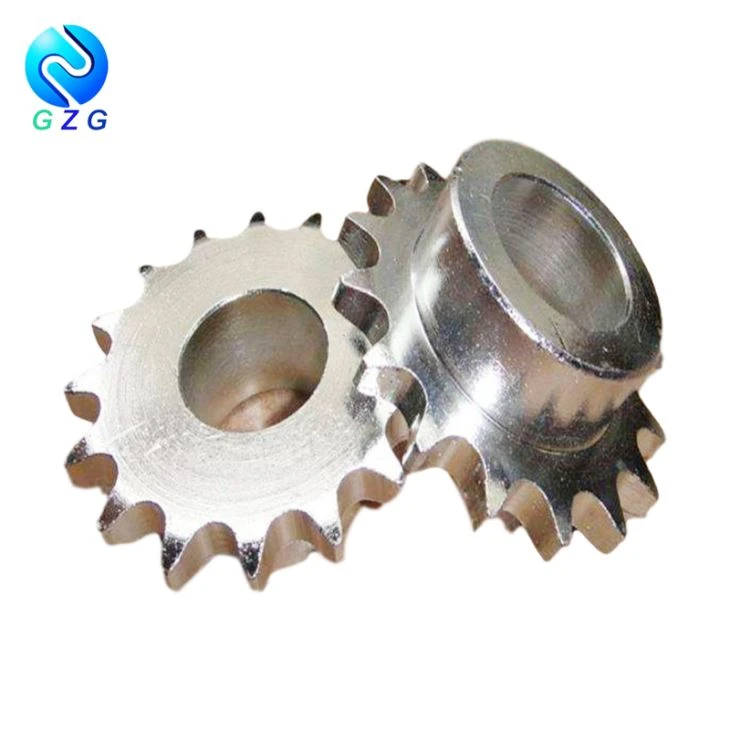
Understanding Standard Sprockets
Standard sprockets are designed and manufactured according to well - established industry standards. These standards, such as those set by the American National Standards Institute (ANSI) or the International Organization for Standardization (ISO), define specific dimensions, tooth profiles, and tolerances. For instance, the pitch (the distance between corresponding points on adjacent teeth), the outer diameter, and the bore size are all precisely defined.
The manufacturing process of standard sprockets is highly streamlined. Mass - production techniques can be employed because of the uniformity in design requirements. Manufacturers use high - precision machinery, such as CNC (Computer Numerical Control) lathes and milling machines, to ensure that each sprocket meets the exact specifications. The use of standardized tooling and fixtures also contributes to the high level of manufacturing precision. As a result, the dimensional accuracy of standard sprockets is typically very high, with tolerances often in the range of micrometers.
The tooth profile of standard sprockets is carefully engineered to ensure smooth engagement with the chain. This reduces wear and tear on both the sprocket and the chain, and also minimizes noise and vibration during operation. The surface finish of standard sprockets is also well - controlled, which helps to improve the overall performance and durability of the sprocket - chain system.
The World of Non - Standard Sprockets
Non - standard sprockets, as the name suggests, do not conform to the standard specifications. They are custom - designed to meet the unique requirements of specific applications. These requirements can vary widely, from non - standard pitch sizes to special tooth profiles or unusual mounting configurations.
The manufacturing precision of non - standard sprockets is a more complex topic. On one hand, the same high - precision manufacturing equipment used for standard sprockets can be utilized. However, the custom - nature of non - standard sprockets often presents challenges. For example, when dealing with a non - standard pitch, the cutting tools may need to be specially designed or modified. This can introduce additional sources of error and make it more difficult to achieve the same level of precision as with standard sprockets.
In some cases, non - standard sprockets may require more complex manufacturing processes. For instance, a sprocket with a custom tooth profile may need to be machined using multi - axis CNC machining centers, which require more advanced programming and setup. These processes can be time - consuming and may be more prone to errors, especially if the design is very intricate.
Differences in Manufacturing Precision
Dimensional Accuracy
One of the most significant differences in manufacturing precision between non - standard and standard sprockets lies in dimensional accuracy. Standard sprockets have a well - defined set of dimensions, and manufacturers can achieve very tight tolerances. For example, the pitch of a standard ANSI sprocket may have a tolerance of ± 0.05 mm. In contrast, non - standard sprockets may have looser tolerances, especially if the design is highly customized. A non - standard sprocket with a unique pitch may have a tolerance of ± 0.1 mm or more, depending on the complexity of the manufacturing process.
The outer diameter and bore size of non - standard sprockets can also deviate more from the intended values compared to standard sprockets. This is because the manufacturing process for non - standard sprockets may involve more manual intervention or less - optimized tooling. For example, if a non - standard sprocket has a non - circular bore, it may be more difficult to achieve the same level of roundness and concentricity as a standard sprocket with a simple circular bore.
Tooth Profile Precision
The tooth profile of a sprocket is critical for its proper functioning. Standard sprockets have a well - defined tooth profile that is optimized for chain engagement. The manufacturing process for standard sprockets ensures that the tooth profile is consistent and accurate across all teeth.
Non - standard sprockets, on the other hand, may have custom tooth profiles. These profiles can be designed to meet specific requirements, such as reducing noise or increasing load - carrying capacity. However, achieving the same level of precision in the tooth profile for non - standard sprockets can be challenging. The custom tooth profile may require special cutting tools or machining techniques, and any small error in the manufacturing process can have a significant impact on the performance of the sprocket - chain system. For example, a slight deviation in the tooth profile can cause uneven wear on the chain, leading to premature failure.
Surface Finish
Surface finish is another aspect where there are differences in manufacturing precision. Standard sprockets typically have a smooth and consistent surface finish. This is achieved through processes such as grinding and polishing, which are well - established in the mass - production of standard sprockets.
Non - standard sprockets may have a more variable surface finish. The custom - nature of the manufacturing process may mean that some areas of the sprocket are more difficult to machine to the desired surface quality. For example, a non - standard sprocket with complex geometries may have areas where it is challenging to access with the finishing tools. Additionally, the use of non - standard materials or heat - treatment processes can also affect the surface finish.
Examples of Non - Standard Sprockets
There is a wide range of non - standard sprockets in the market. For example, Plastic sprocket is a type of non - standard sprocket that is often used in applications where weight reduction, corrosion resistance, or noise reduction is required. The manufacturing of plastic sprockets may involve injection molding, which has its own set of challenges in terms of achieving high precision, especially in terms of dimensional accuracy and tooth profile definition.
HUB Chain Sprocket C Type is another example of a non - standard sprocket. This type of sprocket has a specific hub design and may be used in specialized machinery. The custom hub configuration requires additional machining steps, which can increase the complexity of the manufacturing process and potentially affect the precision.
Black Sprocket On Surface and Galvanized Sprocket On Surface are non - standard sprockets with special surface treatments. These treatments not only add functional properties such as corrosion resistance but also introduce additional manufacturing steps that can impact the overall precision.
The Importance of Precision in Non - Standard Sprockets
Despite the challenges in achieving the same level of precision as standard sprockets, precision is still of utmost importance in non - standard sprockets. In many applications, the performance of the entire system depends on the proper functioning of the non - standard sprocket. For example, in a high - speed conveyor system, a non - standard sprocket with poor precision can cause chain slippage, which can lead to production downtime and increased maintenance costs.
In aerospace or automotive applications, non - standard sprockets need to meet very strict performance requirements. Any deviation in precision can have serious consequences, such as reduced efficiency, increased wear, or even safety hazards. Therefore, as a non - standard sprocket supplier, we invest heavily in advanced manufacturing technologies and quality control measures to ensure that our sprockets meet the highest possible precision standards.
Conclusion
In conclusion, the manufacturing precision of non - standard sprockets differs from that of standard sprockets in several aspects, including dimensional accuracy, tooth profile precision, and surface finish. While standard sprockets benefit from well - established industry standards and mass - production techniques, non - standard sprockets face unique challenges due to their custom - nature. However, with the right manufacturing processes and quality control measures, high - precision non - standard sprockets can be produced to meet the specific needs of various applications.
If you are in need of non - standard sprockets for your project, we are here to help. Our team of experts has extensive experience in Non - standard sprocket manufacturing and can work with you to design and produce the perfect sprocket for your requirements. Contact us today to start the procurement and negotiation process.
References
- ANSI Standards for Sprockets
- ISO Standards for Mechanical Power Transmission
- Machinery's Handbook, 30th Edition